why scientists love one sec
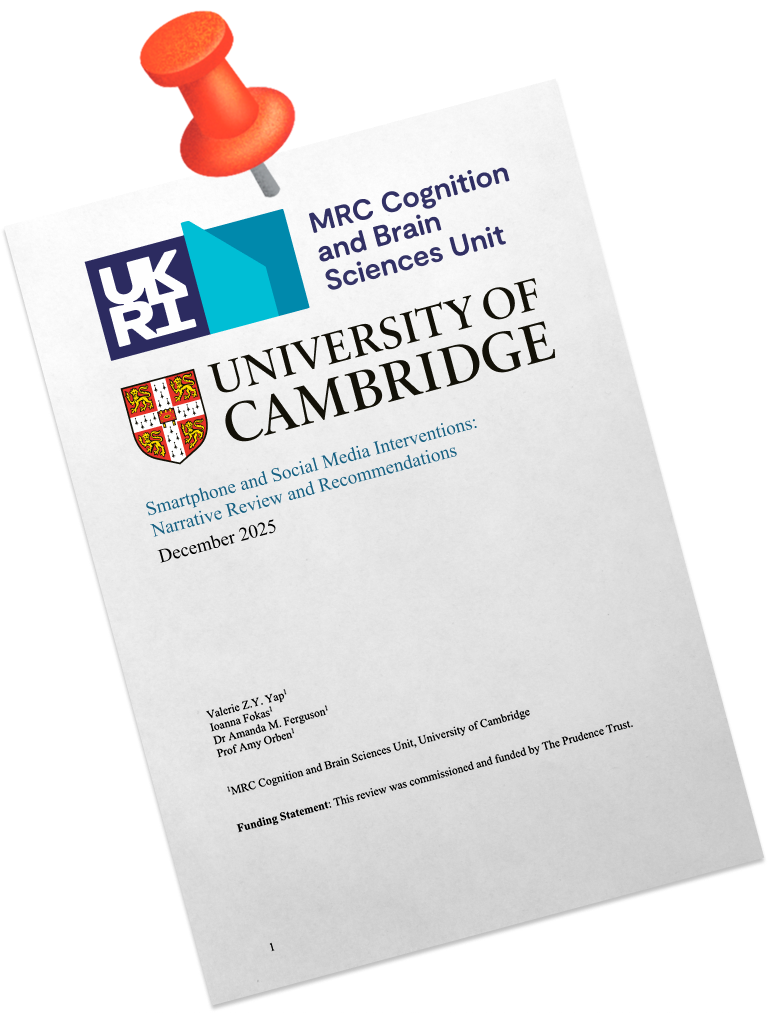
We have big news! The University of Cambridge just released a report on the landscape and evaluation of focus and social media interventions, including focus apps. And one sec is presented there quite prominently!
For us, this isn’t as surprising. Accordingly, this article will be a humble brag about:
- why one sec is loved by many scientists,
- about the research and insights we’ve gathered with them for years now
- how we manage to respect data and privacy at the same time
- and of course, about the goals, methods, and findings of the Cambridge report here.
one sec and research
When you first installed one sec, it’s likely you saw a banner like this …
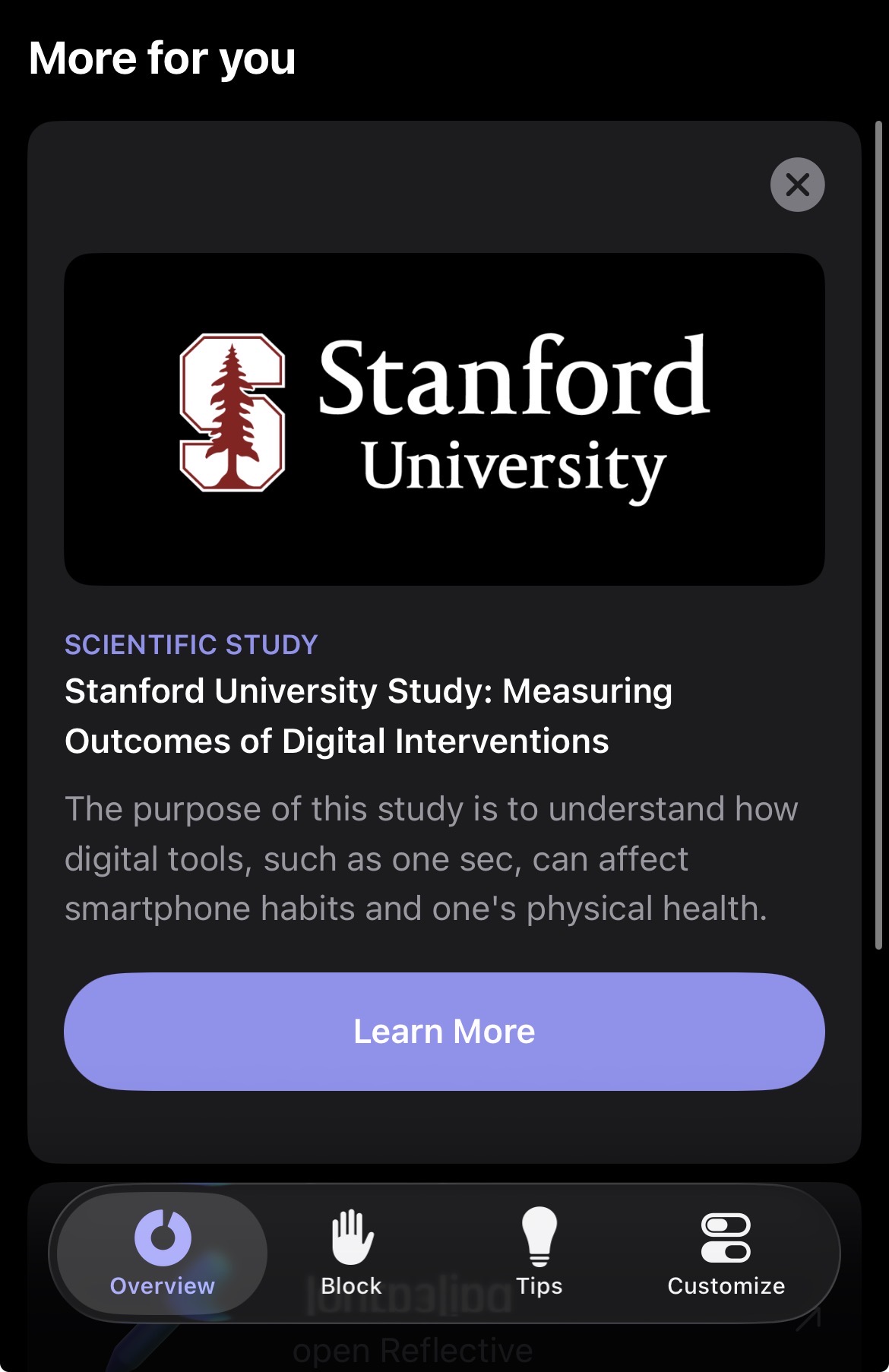
… asking you to opt in to a research project. Over the years, there have been many of those banners in the app.
For independent researchers it has been nearly impossible to look closely at the effects and behavior impact of social media for a long time:
The big tech corporations behind apps like Instagram, TikTok or YouTube are hesitant about sharing their data or even the results of their own studies with independent researchers. They have nothing to win, but a lot to lose.
one sec fills that gap: it acts as a neutral layer between social media, users, and researchers.
Everything started with a Tweet
The funny thing is, our research journey with one sec began on social media: When Frederik launched one sec, he tweeted about his project and showed a screen recording of what the app can do. A researcher at Max Planck Institute saw this – and messaged Frederik.
So all in all, social media is a good thing, I guess. If you use it intentionally and as a tool. And that’s what one sec is all about.
David Grüning, the Max-Planck researcher, praised Frederik’s approach, emphasizing that this is exactly what he and his colleagues were researching on – and asked if he was open to collaborate for a study in the app.
The result was this paper …
https://www.pnas.org/doi/10.1073/pnas.2213114120
… but for Frederik, this was also an opportunity. A chance to develop one sec into an even more effective tool. To prove and examine his approach – the one that initially helped himself – scientifically.
And with time he decided to publish his app on the App Store and realized it gained an even deeper meaning for him: helping the global science community by providing social media usage data in an ethical (!) way.
How one sec protects your privacy
First a big INDIE APP-PROMISE:
one sec does not save, sell or forward any of your data.
Ever.
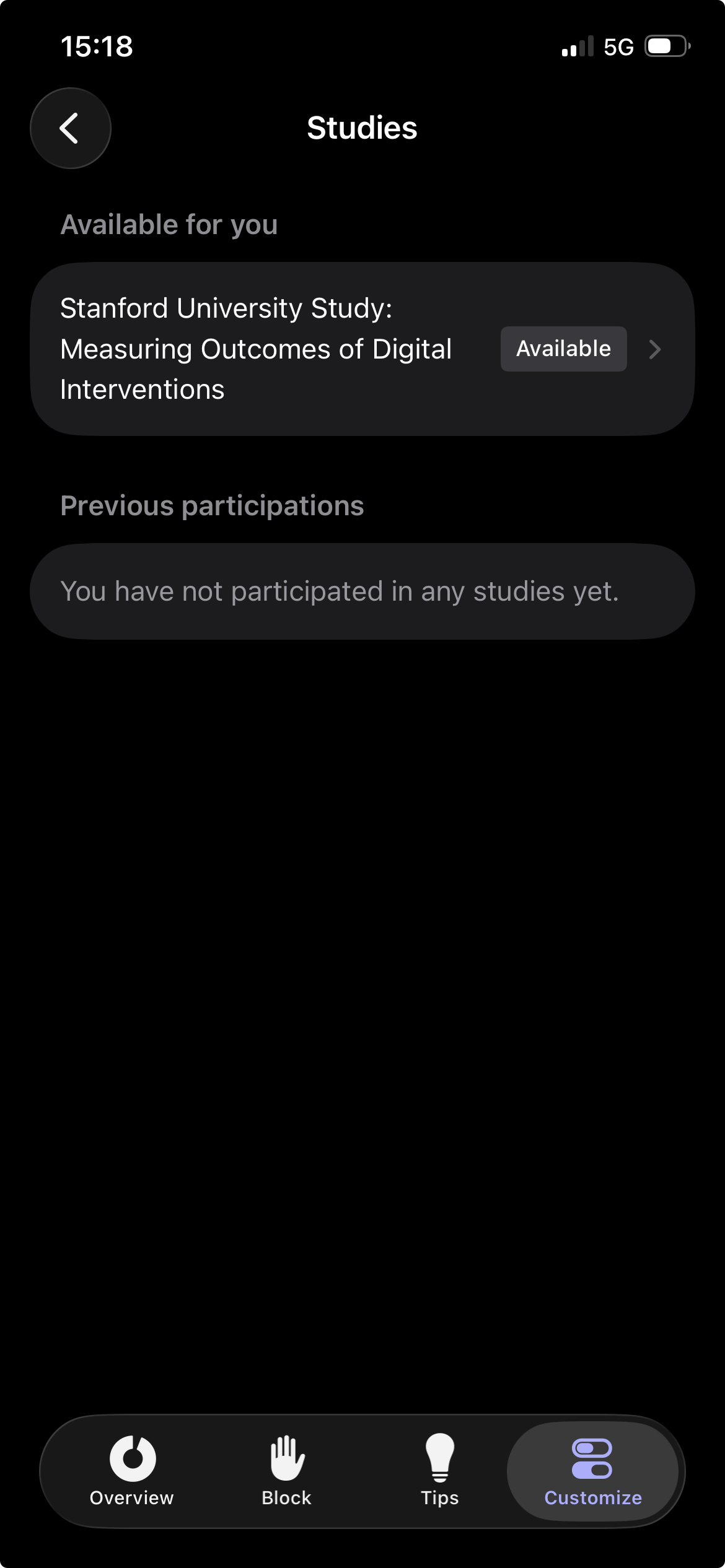
If you decide to share your data with researchers, you need to actively opt-in to our research studies. You saw the banner earlier in this article – or maybe you found this page in one sec’s customize section.
Both are invites to be part in a ongoing research study.
The design of the studies are often evaluated by ethic commissions of the universities and institutions; maintaining high standards for privacy and data-collection.
Also, we implement tools for collecting specific data just as long as the study runs and you are opted in. After the study is over, everything goes back to normal! So the researchers can only track the data they are actually interested in.
A really big part of doing research about social media is to actually understand psychological mechanisms of what makes people change their behavior effectively. one sec was already related in research about:
- Friction (Interruption by small delays or extra steps, like one sec’s breathing intervention)
- Self-Monitoring/Awareness (redirecting attention towards intentional use, e.g. one sec’s opening attempts counter)
- Access Control (External restrictions reducing access to online spaces; e.g. one sec’s block session)
- Knowledge Building (education about technology impacts, digital literacy; e.g. reading this really informative blog post)
- Self-Regulation (internal capacity to regulate your behavior; e.g. training programs for self-efficacy)
- Mediation/Modelling (dialogue and shared problem solving, reinforcing desired behavior by demonstrating them; e.g. parents using and talking about one sec in front of their kids)
These insights can be very valuable. For example, regarding the general understanding of reality: How do certain target groups (e.g. adolescents) even use Snapchat, TikTok and other apps?
Or which interventions and strategies actually reduce this loss of control produced by the persuasive design of smartphones and social media.
Especially young people are very vulnerable to this persuasive designs: In adolescence, they just start developing self-regulation. This is why governments, schools, families and the affected individuals search and implement actively different interventions fighting this problem for a while now.
While Australia was implementing a social media ban for minors, Germany gave minors free access to one sec. Denmark even started a giant study on the effects on different age groups / user groups – feeding the legislation to proposing stricter social media regulations, based on age.
The Cambridge Report
Researchers at the University of Cambridge also followed this kind of intervention implementation. But they noticed fast that the research on these interventions was spotty.
To further promote healthier digital engagement & less compulsive phone usage, they started their own research.
By sorting and evaluating 70 (!) different interventions: On their psychological mechanism, their implementation level and their quality of research – ending with recommendations which interventions are actually ready to be implemented for real-world use.
Here’s what they found out:
- The evidence is lacking for many,
- and the interventions are implemented in many different ways and environments.
- The findings also suggest that the mechanism is more important than in which environment it is happening.
- They state there is nearly no long-time data; effects often show that they wear down. Can’t say if they help with sustained self-regulation and positive mental health outcome.
But what is different about one sec?
How our lead of research, Dr. David Grüning summarized it:
one sec is the only app that is “widely used” ***and “***proven & scalable”, all other widely adopted apps are “widely adopted but unevaluated,” which is an enormous difference.
The report proves why one sec is loved by scientists: in the app domain, one sec is the best choice as a research tool by far. The other apps in the same rank are either non-existent or have no actual product/application available.
This means for one sec’s users, that our features are actually supported by scientific evidence and our ongoing experiments ensure we’re always at the forefront of cutting-edge and innovative social media interventions.
Our cooperations all over the globe
Today we are proudly cooperating with more than 30 universities and institutions around the world, with leading experts in psychology & digital wellbeing, including:
- Stanford University
- Harvard University
- Max-Planck Institute for Human Development
- University of Cambridge
- University of Oxford
- UC Berkeley
- ETH Zurich
- University of Amsterdam
- King’s College London
- University of Zurich
- University of Bern
- University of Heidelberg
- DTU Compute, Technical University of Denmark
- University of Exeter
- National Health Services, UK (NHS)
- German Federal Agency for the Protection of Children and Young People in the Media (Bundeszentrale für Kinder- und Jugendmedienschutz)
- Danish Competition and Consumer Authority (DCCA)
You are a researcher and want to do research with us? → https://one-sec.app/research/
You want to bring one sec to your university or school? → https://one-sec.app/us/schools/
Lucas Strehle
September 22, 2026